
Columbia Busted Arrest Records
Columbia is Richland County's seat and its biggest city. The 2020 Census put 136,632 people there. Most city arrests are handled by the Columbia Police Department, known as CPD. It is not the only agency that can make one, though. It does not run a jail either. A police report, a county booking record, and a court case sit with three separate custodians.
Where things land depends on the county. On the Richland side, a CPD arrest goes to the city Municipal Court, which uses Alvin S. Glenn Detention Center for bond hearings. ASGDC sits at 201 John Mark Dial Drive. Richland County says people may be held there while awaiting court or serving a county sentence. The Lexington portion works differently, running through a separate Municipal Court session. The city name alone cannot pick the right detention system.
When you are unsure of the source, keep the questions apart. Ask CPD about the police event. Ask the receiving county about custody. Ask the responsible court about the case. That split matters most in Columbia, where a municipal arrest can cross a county line without the city name changing at all.
A booking or arrest report shows what police filed that day. Charges can change, be dropped, or move to another court, so the court record is the place to check how a case ended.
Where Columbia Busted Mugshots Appear
Go to official channels first. CPD publishes selected announcements. ASGDC's JMS form answers a narrow current-custody question. Neither one offers a daily arrest list or a public gallery of booking photos. The table below separates those official routes from later unofficial publisher listings. That way a retained image or date is never mistaken for present custody.
| Channel | Photo posture | Status | What it answers |
|---|---|---|---|
| CPD press releases | Varies by release | Official, selective | Selected arrests, investigations, wanted notices, and updates, not every booking. |
| ASGDC JMS Public Access | Not promised online | Official | Current Richland County custody by first name, last name, and CAPTCHA. |
| Richland County public records | Request if maintained and releasable | Official | A targeted ASGDC booking record or booking-photo request. |
| WIS News 10 Crime | Story images vary | News, verify | Selected Midlands reporting that should be checked against the agency and court. |
| RecentlyBooked Richland | Publisher display may include images | Unofficial | A publisher's county-attributed listing, not proof of custody, source accuracy, or outcome. |
| Arrests.org Richland | Publisher display may include images | Unofficial | A rolling publisher display whose city label does not establish arrest agency or county side. |
The city's own publication is CPD's official press-release archive. It posts arrest and investigation news on an irregular schedule. There is no daily roster here. No 24- or 48-hour booking list. No browseable detention record. An entry may not even include a photo. In short, the CPD release archive is a selective news source rather than a custody list.
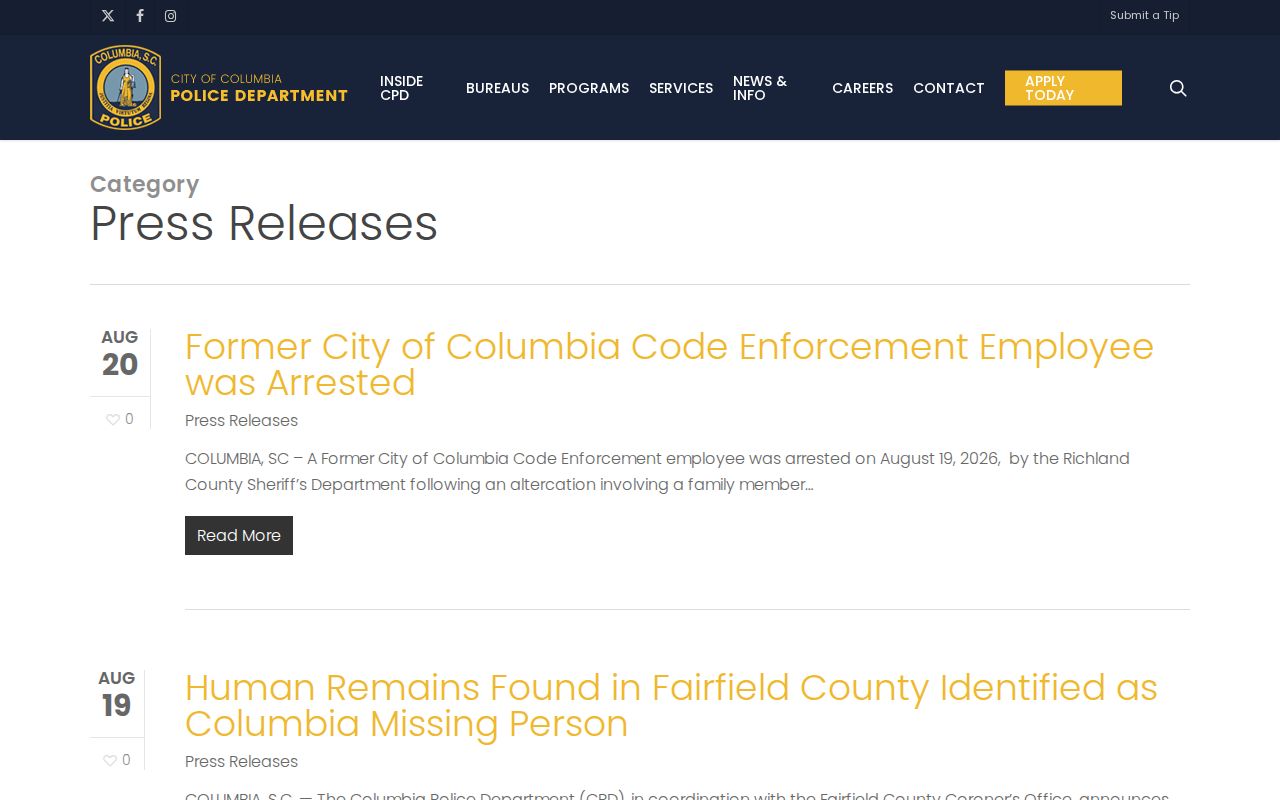
A release can add useful context to a reported Columbia case. Silence cuts the other way, though. An absent release does not show that no arrest occurred or that a person walked free.
Note: A booking image held by an unofficial publisher cannot establish the current custody status or the final court result for a Columbia case.
Busted in Columbia: Custody Lookup
Separate the police event from the custody question before anything else. For a Richland County event, the official route is the ASGDC JMS form. It asks for a first name, a last name, and a CAPTCHA. It has no browse-all list. No date range, no booking-number field, no charge filter. ASGDC, CPD, and RCSD publish no same-day, 48-hour, 72-hour, weekly, or archived booking feed.
- Confirm the incident county from the report, location, case information, or arresting agency. A Columbia address alone is not enough because city limits cross the county line.
- For a Richland booking, use the ASGDC current-detainee search with the person's legal first and last name, then complete the CAPTCHA.
- Record the time checked and any agency or court details returned. A result is a current-custody signal, not a court disposition or a complete arrest history.
- If no result appears, request the relevant police or county record and search the appropriate court record. Release, transfer, protected status, spelling, or another detention location can all explain an absence.
Custody details for the whole county, feed included, live on the Richland County lookup page. SCDC is a different animal. It covers people already sentenced to state prison. So treat its public search as its own channel, not a substitute for a fresh Columbia booking check.
Columbia Police Report Records
Start with CPD's Records Unit. It holds incident, vehicle-crash, patrol, and investigative reports, which makes it the practical first stop for anything the department created. Privacy rules apply, though, and the City says so plainly. Reports may arrive redacted. Some may not arrive at all. Nothing is given over the telephone, so a precise written request beats a call every time.
Columbia Police Department Records Unit
Address:
1 Justice Square
Columbia, SC 29201
Records line: 803-545-3577
Hours: Monday through Friday, 8:30 a.m. to 5:00 p.m.
Non-emergency response: 803-252-2911
Fees depend on timing and who is asking. Within the first 14 days, CPD charges $3 for a non-victim incident report. Victims pay nothing. Older non-victim requests go through the City's FOIA process instead. The City of Columbia FOIA office runs an online submission and tracking portal, and its posted schedule lists $20 per hour for search, retrieval, and redaction work, plus a $5 disc. Those fees cover the request itself. They don't promise that every report or image can be released.
Aim requests at the right office. Ask CPD or the City for anything CPD created. For detention material, ask Richland County or ASGDC, naming the person, the approximate booking date, the arresting agency, and any booking or detainee number. That split keeps a police report request from being read as a request for a jail photo.
Columbia Booking Records by County
One local fact decides where a Columbia arrest record lands: the county line. Columbia police who bust someone inside Richland County send bond court to ASGDC. Cross the line into Lexington County and the arrest runs through separate sessions at Columbia Municipal Court instead. The split matters for anyone hunting booking records. Neither a CPD press release nor a third-party tag on a city arrest tells you with confidence which jail took the person in.
- Richland-side CPD arrest
- Use ASGDC JMS for a current custody check, then Richland County/ASGDC for a narrow booking-record request when necessary.
- Lexington-side CPD arrest
- Use the relevant Lexington County official custody and court channels. Do not assume a Richland search is complete for that event.
- CPD incident report
- Start with CPD Records or the City's FOIA channel, because the police report and the detention record have different custodians.
Two more distinctions save searchers real time. First, the public JMS form makes no promise of a booking photo, so a targeted county request is the official fallback for a named ASGDC record, provided that record exists and is non-exempt. Second, county custody and state custody are different things. SCDC's official search only works once a person has been sentenced and is currently housed in a state prison.
Note: A court case may continue after release or transfer, so current jail custody and the status of a Columbia criminal case are different questions.
Columbia Busted News Sources
Official sources come first for Columbia arrest information. CPD releases lead the list. Richland County, ASGDC, and the courts supply the related record. RCSD's press-release archive adds countywide investigations. WIS News 10 and The State both report on local crime and courts, though what they cover and which photos they run are editorial calls. A picture in a news story is not a live jail record.
Secondary sites deserve more caution. RecentlyBooked and Arrests.org run Richland-local publisher pages that may label an event as Columbia, but those pages are unofficial. So confirm the agency, date, charge, custody status, and outcome through the arresting agency, ASGDC for Richland events, and the court. For wider local-media context, the Richland County crime-news resource fills in the picture without pretending news coverage is a booking roster.
Court Status After a Columbia Arrest
A booking opens a case. It never ends one. The statewide starting point for tracking what happens next is the official South Carolina Public Index. Pick the responsible county and court agency. Enter a case number if you have one. Then read the status, dates, events, and public documents closely, because a name match by itself can point to the wrong person.
Felony and higher-court matters in Richland go through Richland General Sessions. There the Clerk holds warrants, indictments, bond papers, sentence sheets, and related files. In short, the Clerk and the Public Index track the court path, while ASGDC answers only current county custody. Charges can change along the way too, through amendment, reduction, or dismissal.
City cases may belong to Columbia Municipal Court, whose published bond-court information helpfully splits CPD arrests by county. Match the court agency to the incident and case number rather than treating a General Sessions search as the whole file. One quirk deserves note: a case can keep moving even after ASGDC no longer returns a name, so the court file is how you follow the later stages.